
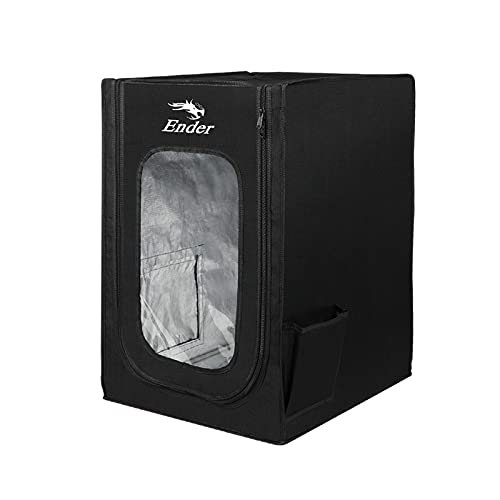
- PLA doesn't need an enclosure to print well. It's the material makers most often say is fine on an open frame, since it doesn't demand a stable chamber temperature the way ABS or ASA do.
- PLA is not automatically the 'safe' choice, though. One study found PLA emitted more ultrafine particles than ABS on the same printer, so an enclosure's dust and draft control still has a real case.
- The real reasons to enclose a PLA-only printer are dust, drafts and pets or kids, not fumes specifically.
- An enclosure doesn't unlock new materials by itself; an open-frame printer that isn't rated for ABS or ASA stays that way with a tent added, regardless of what the tent's listing claims.
An enclosure isn’t structurally necessary for PLA the way it is for ABS or ASA, since PLA prints at lower temperatures and doesn’t need the stable chamber those materials do. That doesn’t mean PLA has no case for enclosing a printer at all; the real reasons just aren’t about fumes specifically.
Why PLA doesn’t need an enclosure to print well
Bambu’s own A1 mini tech specs list PLA, PETG, TPU and PVA as ideal materials on its open-frame design, with ABS and ASA not recommended. That’s a printing-quality distinction: PLA cools and sets without the warping risk a draft causes on ABS or ASA, so an open-frame printer handles it fine.
Where “PLA is safe” stops being accurate
Printing quality and emissions are two different questions. One published study found the same desktop printer emitted more ultrafine particles running PLA than running ABS on that unit, a finding this site’s own emissions research page for enclosed printers cites directly. So “PLA doesn’t need an enclosure to print well” and “PLA produces nothing worth controlling in the air” are not the same claim, and treating them as the same one is the mistake this question usually hides.
The real case for enclosing a PLA-only printer
Dust and drafts, not fumes specifically, are the practical reasons to enclose a printer that only ever runs PLA. An enclosure or tent keeps household dust off a print running for hours, evens out temperature swings from a nearby window or vent that can still affect fine detail, and puts a physical barrier between a hot nozzle and a curious pet or young child. None of that requires the material itself to demand an enclosure.
What an enclosure doesn’t do
Adding a tent or enclosure to an open-frame printer doesn’t change what that printer’s own frame is rated for. A printer not recommended for ABS or ASA stays that way with an enclosure added, regardless of what a third-party tent’s listing implies about “handling higher temperatures.” Check the printer maker’s own material guidance, not the enclosure’s marketing copy, before assuming an add-on unlocks a new material.
Which related guides help next
- 3D printer enclosure tents: do they cut noise, or just fumes?
- 3D printing in an apartment with no window: enclosed printers with filters
- PLA vs PETG vs TPU: which filament should a beginner start with
- Bed slinger vs CoreXY: does it matter for a first 3D printer?
PLA-only enclosure questions
Does PLA need a stable chamber temperature the way ABS does?
No. PLA prints at lower temperatures and cools without the same warping risk that makes ABS and ASA hard to print on an open frame in a drafty room. Makers commonly list PLA as fine on an open-frame printer for that reason.
So is PLA completely safe to print in an open room?
Don't assume that. One study found the same printer emitted more ultrafine particles running PLA than running ABS, so 'PLA doesn't need an enclosure structurally' isn't the same claim as 'PLA produces nothing worth controlling.'
What's the actual case for enclosing a PLA-only printer?
Dust, drafts, and keeping pets or young kids away from a hot nozzle and moving parts, not fumes specifically. A tent or enclosed printer does that job regardless of which filament is loaded.
If I add an enclosure later, can I start printing ABS on an open-frame printer?
No, not automatically. The printer's own frame, not just an added enclosure, determines whether ABS or ASA is a supported material. Check the specific printer's own material guidance before assuming an enclosure changes that.
Sources we checked
- Steinle P, 'Characterization of emissions from a desktop 3D printer and indoor air measurements in office settings.' Source for PLA emitting more ultrafine particles than ABS on that printer.Independent · pubmed.ncbi.nlm.nih.gov · checked
- Bambu Lab: A1 mini tech specs. Source for PLA/PETG/TPU/PVA being listed as ideal materials on an open-frame printer, with ABS/ASA not recommended.Manufacturer · bambulab.com · checked
- Amazon: Creality Enclosure Tent listing (ASIN B0995VTBLS), re-verified in stock via Amazon product data. Source for this page's tent pick, its price and its image.Retailer listing · amazon.com · checked