
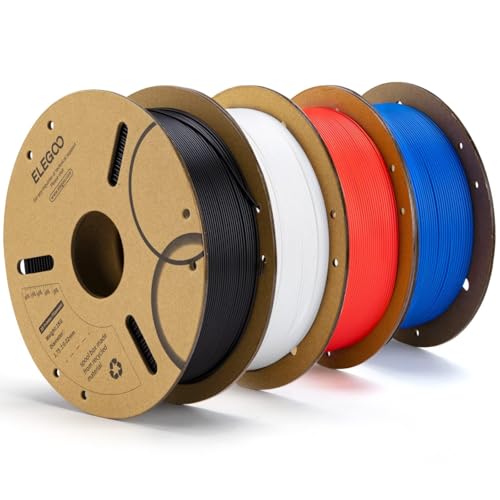
- Start with PLA. It prints at the lowest temperature, warps the least, and is the most forgiving of imperfect settings of the three.
- PETG is the natural second filament, trading some of PLA's ease for real strength and heat resistance gains for functional parts.
- TPU is not a beginner filament. Its flexibility makes it prone to tangling or binding in a printer that isn't direct-drive, and it rewards patience more than a first project should demand.
- Heat is PLA's real limit: it softens around 60°C, so a PLA part left in a hot car or near a window in direct sun can warp on its own, with no printer involved.
For nearly every first-time buyer, the right filament to start with is PLA, then PETG once a real limit shows up, with TPU as a later, more deliberate purchase rather than a first one.
Quick answer: Start with PLA, and move up in that order: PLA first, PETG when a part needs to survive heat or stress, TPU last. PLA prints at the lowest temperature and warps the least; its one real limit is heat, softening around 60°C. TPU is not a first filament.
Why is PLA the one to start with?
PLA prints at the lowest temperature of the three, needs no enclosure, warps the least, and holds crisp detail even when settings aren’t perfectly tuned. It’s made from renewable feedstocks like sugar cane or corn starch, and it’s the cheapest of the three per spool. Its real limit is heat: PLA softens around 60°C, so a printed part left in a hot car, on a sunny windowsill, or in contact with something hot can warp on its own, independent of print quality. It’s also more brittle under sudden stress than PETG or TPU.
When should you move up to PETG?
PETG keeps most of PLA’s relative ease of printing while adding real strength and heat resistance, making it the natural next filament for functional parts rather than display pieces: brackets, outdoor parts, or anything that needs to survive more heat or stress than PLA can take. It prints hotter than PLA and is somewhat more prone to stringing, but it doesn’t demand the enclosure or tuning that engineering filaments like ABS or ASA do.
Why is TPU not a beginner filament?
TPU is a urethane-based elastomer with rubber-like flexibility, useful for phone cases, gaskets, or shock-absorbing parts. That same flexibility is what makes it hard to print well: it tends to tangle or bind in extruders that aren’t direct-drive, and getting a clean TPU print takes more patience and slicer tuning than PLA or PETG. Treat it as a filament to add once you know your specific printer’s quirks, not one to start on.
What’s the practical progression between the three?
Start every new printer on PLA, regardless of which of this site’s comparison pages led you to it. Move to PETG the first time a project needs to survive heat or stress PLA can’t. Only buy TPU once you’re comfortable troubleshooting your printer without help, since a bad first TPU print is more likely to look like a broken extruder than a filament-choice mistake.
Which related guides help next
- Why won’t my first 3D print stick to the bed, and how do I fix it
- A filament dryer under $100 for PETG and TPU in a humid apartment
- 3D printer first-year cost: filament, nozzles, dryer
- What filament works with the Bambu Lab A1 mini and AMS lite?
Filament choice questions
Why is PLA recommended for a first printer specifically?
It prints at a low temperature with no enclosure needed, warps very little, and holds crisp detail even with imperfect settings. Independent beginner guides consistently call it the most forgiving of the common filaments, which matters most while you're still learning your specific printer's quirks.
When should I move to PETG?
Once PLA's heat limit becomes a real problem for what you're printing: PLA softens around 60°C, so anything that sits in a hot car, near a sunny window, or holds hot liquid is a PETG candidate instead. PETG keeps most of PLA's ease of printing while adding real strength and heat resistance.
Why isn't TPU a good first filament?
TPU's flexibility, the thing that makes it useful for phone cases or shock-absorbing parts, is also what makes it hard to print. It tends to tangle or bind in extruders that aren't direct-drive, and getting a clean print takes more patience and tuning than a beginner's first few projects should require.
Can I print all three on the same printer?
Usually yes for PLA and PETG on the same beginner printer. TPU printing well depends more on the printer's extruder design (direct-drive helps a lot) than PLA or PETG do, so check the specific printer's TPU guidance before assuming it will print TPU cleanly.
Sources we checked
- Cross-checked beginner filament guides (The 3D Printer Bee, TheCADHub, Makers101). Source for the PLA-first, PETG-second, TPU-later progression and each material's stated tradeoffs.Independent · the3dprinterbee.com · checked
- Amazon: ELEGOO PLA 4 kg Bundle listing (ASIN B0BV2CHG55), re-verified in stock via Amazon product data. Source for this page's filament pick, its price and its image.Retailer listing · amazon.com · checked