The shortlist, with today's price
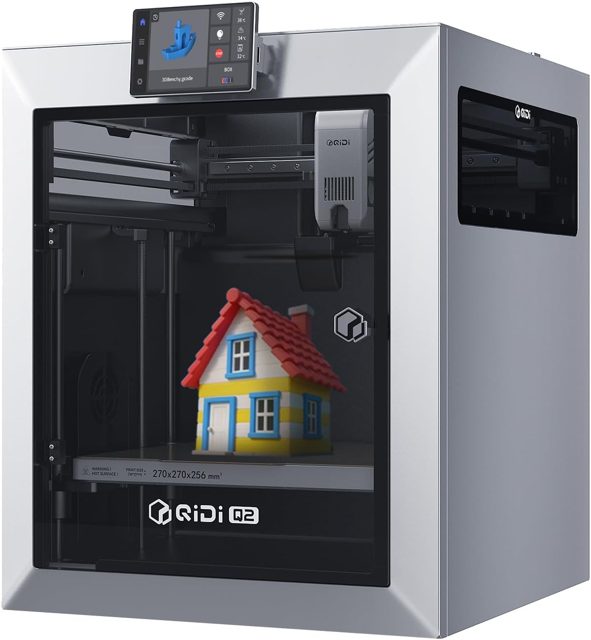
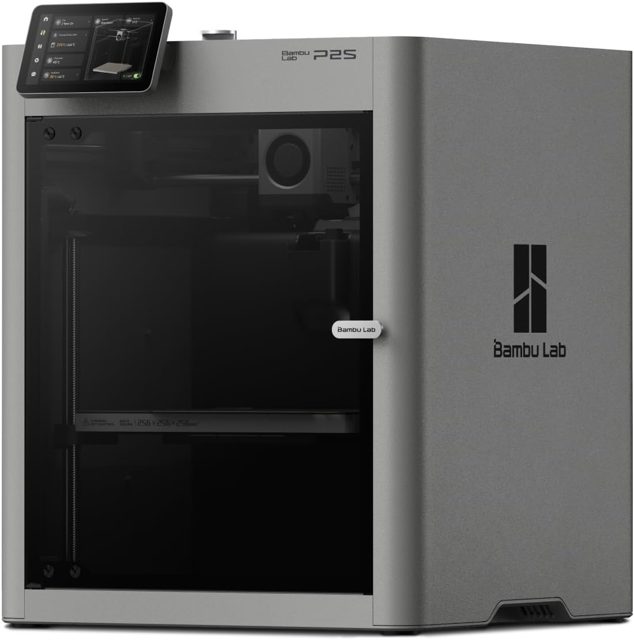
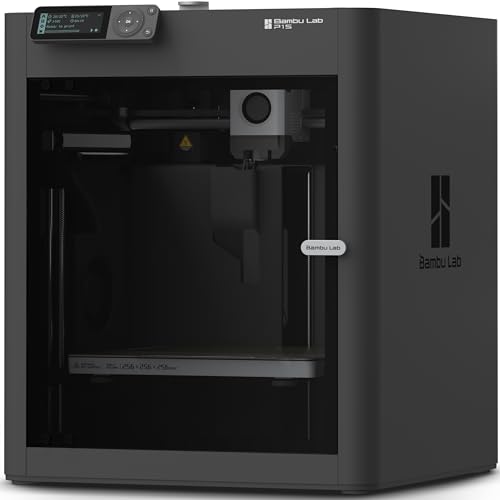
Side by side
| Printer | Path station | Build size | Enclosed | Filament | Price |
|---|---|---|---|---|---|
| QIDI Q2Heated Chamber Plus a Real Filter | 4 Multi-material | 270 × 270 × 256 mm | Yes, active 65C heated chamber (PTC heater) | PLA, ABS, ASA, PETG, TPU, PA, PC, PPS-CF | $449.00 |
| Bambu Lab P2SPassive Enclosure, Published Filtration Lines | 4 Multi-material | 256 mm cube | Yes, door sensor + activated carbon; maker states VOC filtration supported | PLA, PETG, ABS, ASA, TPU | $479.00 |
| Bambu Lab P1SEnclosed Bambu With a Carbon Filter | 4 Multi-material | 256 mm cube | Yes, with activated-carbon filter | PLA, PETG, ABS, ASA, TPU | $349.00 |
Amazon prices as of Nov 23, 2026. Specs from each maker's own page, linked in each pick's build sheet.
Where these printers sit on the upgrade path
- Kid printer
- A1 mini class
- Full-size
- Enclosed multi-materialOutgrow first: rarely outgrown by a home beginnerQIDI Q2Bambu Lab P2SBambu Lab P1S
Stations follow build size, filament range and enclosure from each maker's spec page. The whole path
Each pick, and when you'd outgrow it
QIDI Q2
If ABS fumes in a shared room are half the reason you want an enclosure, the Q2 is the only pick that pairs heated-chamber printing with a named HEPA-and-carbon path.
$449.00 at Amazon, as of Nov 23, 2026
- Build size
- 270 × 270 × 256 mm
- Enclosed
- Yes, active 65C heated chamber (PTC heater)
- Filament
- PLA, ABS, ASA, PETG, TPU, PA, PC, PPS-CF
You'll outgrow it when a multi-unit farm - the 270x270x256 heated build already covers ABS/ASA parts
Ownership checks
- Cloud and firmware · Not checked
- Recalls · Clear
- Spare parts · Not checked
- Maker claims · Clear
Full build sheet
Best for: ABS in a room you breathe in, where filtration matters as much as layer adhesion
- QIDI publishes "Second-Gen 65℃ active chamber heating" and a 120C bed, the warmest stated chamber on this page
- The only printer here publishing a three-stage filter by name: G3 pre-filter, H12 HEPA, coconut-shell activated carbon
- Hotend rated to 370C with PPS-CF on the supported list, so engineering filaments beyond ABS are on the table
- 270x270x256 mm build volume, so a part wider than 270 mm or taller than 256 mm will not fit
- Filter performance is a maker claim; no independent test of the Q2's filter exists in the sources we read
- No noise figure published
Year-one starter spend
| Printer | $449.00 |
|---|---|
| 4 kg of PLA | $41.48 |
| Filament dryer | $38.24 |
| Tool kit | $17.99 |
| Starting total | $546.71 |
Amazon prices as of Nov 23, 2026, add-ons from our gift guide. 4 kg of PLA is a starting stock, not a year's use. No sourced price yet for spare nozzles or build plates.
Path and specs from: QIDI: Q2 product page
Bambu Lab P2S
The ecosystem pick: ABS-capable in theory with the most specific published filtration lines of any passive enclosure here, but the chamber is not heated.
$479.00 at Amazon, as of Nov 23, 2026
- Build size
- 256 mm cube
- Enclosed
- Yes, door sensor + activated carbon; maker states VOC filtration supported
- Filament
- PLA, PETG, ABS, ASA, TPU
You'll outgrow it when a multi-unit farm, not a bigger single printer - the P2S is already Bambu's higher tier.
Ownership checks
- Cloud and firmware · Know this Bambu accounts; LAN-only mode documented
- Recalls · Not checked
- Spare parts · Know this Bambu ecosystem; revision so new that third-party coverage is thin
Full build sheet
Best for: A buyer already inside the Bambu ecosystem who prints ABS sometimes, not all day
- Spec sheet lists ABS, ASA, ABS-GF, ASA-CF, PA6-CF, PAHT-CF, PPA-CF and PET-CF as supported filaments
- The only pick publishing both 'VOC Filtration: Supported' and 'Particulate Matter Filtration: Supported' as named lines, plus a door sensor
- The AMS path to multicolor, which the QIDI pick does not match for Bambu owners
- Bambu's store page says "The P2S does not have an active chamber heating function" and lists "50°C Chamber Ready For Engineering-Grade Filaments."; big ABS parts carry more warp risk than on the heated-chamber QIDI pick
- Max hotend temperature is 300C on Bambu's store page, 70C below the QIDI Q2's 370C
- Same Bambu Connect authorization workflow this site's no-cloud page documents for the Bambu ecosystem
Year-one starter spend
| Printer | $479.00 |
|---|---|
| 4 kg of PLA | $41.48 |
| Filament dryer | $38.24 |
| Tool kit | $17.99 |
| Starting total | $576.71 |
Amazon prices as of Nov 23, 2026, add-ons from our gift guide. 4 kg of PLA is a starting stock, not a year's use. No sourced price yet for spare nozzles or build plates.
Path and specs from: Bambu Lab: P2S specs page
Bambu Lab P1S
The passive-enclosure Bambu with a named carbon filter for ABS; the chamber is not heated.
$349.00 at Amazon, as of Nov 23, 2026
- Build size
- 256 mm cube
- Enclosed
- Yes, with activated-carbon filter
- Filament
- PLA, PETG, ABS, ASA, TPU
You'll outgrow it when a print exceeds its 256 mm cube, or a job needs more than one tool head can deliver
Ownership checks
- Cloud and firmware · Know this Bambu's Authorization Control firmware applies to P-series; Developer Mode keeps LAN printing source
- Recalls · Not checked CPSC recall check for the P1S not done yet
- Spare parts · Know this The box list on the Bambu store page names a "Stainless Steel Hotend with Nozzle"; no spare hotend is listed
Full build sheet
Best for: A Bambu buyer who wants an enclosure and a carbon filter for ABS and ASA without a heated chamber
- Bambu's store page lists the shell as "Enclosed (Plastic & Glass)" and ABS and ASA under "Ideal" supported filaments
- Bambu says it equipped the P1S with "an activated carbon filter to provide a solution for printing filaments such as ABS"
- Build volume is 256 x 256 x 256 mm, the same cube as the P2S
- No chamber heater is listed on the store page, so large ABS parts carry more warp risk than on the heated-chamber QIDI pick
- Max hot end temperature is 300 ℃ on Bambu's store page, 70C below the QIDI Q2's 370C
Year-one starter spend
| Printer | $349.00 |
|---|---|
| 4 kg of PLA | $41.48 |
| Filament dryer | $38.24 |
| Tool kit | $17.99 |
| Starting total | $446.71 |
Amazon prices as of Nov 23, 2026, add-ons from our gift guide. 4 kg of PLA is a starting stock, not a year's use. No sourced price yet for spare nozzles or build plates.
Path and specs from: Bambu Lab US store: P1S product page (already cited on this page), Page pick card: 256 mm build cube
No owner reports or revision history collected yet for the printers on this page. Until there are, these picks show only what the maker and regulator sources say.
- An enclosure is not a chamber. A sealed box helps, but the makers that publish a number — QIDI (65C on the Q2) and Creality (60C for ABS/ASA on the K2 Plus, not ranked here while Amazon shows it out of stock) — actively heat the air around the print, which is what large ABS parts actually need.
- Best for ABS: the QIDI Q2 ($449.00 on Amazon as of Nov 23, 2026), "Second-Gen 65℃ active chamber heating", "Max 370°C nozzle temperature", a 120C bed and 270x270x256 mm, in stock on Amazon Nov 11, 2026. The QIDI Plus4 that led this page is out: QIDI's own page now reads "This model has been discontinued."
- The only named filter stack: the QIDI Q2 publishes a three-stage filter (G3 pre-filter, H12 HEPA, activated carbon) in the same 65C active-chamber class that QIDI lists for the Q2.
- A passive enclosure prints ABS with caveats. The Bambu P2S ($479.00 on Amazon as of Nov 23, 2026) and P1S ($349.00 on Amazon as of Nov 23, 2026) list ABS/ASA support and carbon filtration, and Bambu's store page says "The P2S does not have an active chamber heating function"; the same page lists "50°C Chamber Ready For Engineering-Grade Filaments."
- ABS fumes are measured, not debated. Azimi et al. (2016) measured styrene emissions of roughly 10-110 micrograms per minute from ABS filament, and UL Chemical Insights states that ABS "typically print at higher temperatures and consequently release significantly more UFPs and VOCs" (UL); a filter line on a spec sheet is a maker's claim, not a measurement of that printer.
ABS warps because one half of a part shrinks against the other, and the fix is not a box — it is a warm box. The QIDI Q2 is the answer: a published active 65C chamber, a 370C nozzle, a 120C bed and a named three-stage filter in one machine at $449.00 on Amazon as of Nov 23, 2026. Every claim below comes from the maker’s own spec page or a named study, with the date we read it.
Updated Nov 21, 2026: the ELEGOO Centauri Carbon moved to Also considered because Amazon showed no in-stock new offer for it, and the Bambu P1S is ranked in its place, and the Bambu P2S lines now follow Bambu’s store page.
Updated Nov 18, 2026: the Creality K2 Plus moved to Also considered because its Amazon listing is out of stock.
Updated Nov 11, 2026: the QIDI Plus4 is out as #1 because QIDI’s own page now says “This model has been discontinued.”
Why ABS makes the enclosure the whole question
A sealed enclosure and a heated chamber are different products, and only one of them publishes a number. The spec that separates the ranked picks:
- QIDI Q2: “Second-Gen 65℃ active chamber heating” (PTC), straight off QIDI’s product page. That is active heat around the part, not trapped waste heat.
- Bambu P2S: enclosed, Bambu lists ABS-family filaments as supported, and its store page says “The P2S does not have an active chamber heating function” while listing “50°C Chamber Ready For Engineering-Grade Filaments.”
The passive-enclosure pick is not dishonest, but a buyer choosing a printer for ABS deserves to know which spec is doing the anti-warp work. Layer adhesion follows the same curve: a 50-65C chamber keeps consecutive layers closer in temperature, which is where corner-lift and layer cracks come from.
No CPSC recall names any printer ranked on this page (checked Sept 28, 2026); the one 3D-printer recall found names the June 2024 Bambu A1, a different model.
Printers worth starting on
Three enclosed printers are ranked here (Amazon stock re-checked Nov 21, 2026). Ranked by what they publish about the chamber first, filtration second:
- QIDI Q2 ($449.00 on Amazon as of Nov 23, 2026): 65C active chamber, 370C nozzle, 120C bed, and the only named three-stage filter here (G3 pre-filter, H12 HEPA, coconut-shell activated carbon). The build is 270x270x256 mm.
- Bambu Lab P2S ($479.00 on Amazon as of Nov 23, 2026): enclosed without active chamber heating, but with the most specific published filtration lines (“VOC Filtration: Supported”, “Particulate Matter Filtration: Supported”), a 300C hotend and the AMS multicolor path.
- Bambu Lab P1S ($349.00 on Amazon as of Nov 23, 2026): “Enclosed (Plastic & Glass)”, a 300 ℃ hot end, ABS and ASA listed as “Ideal” filaments and an activated carbon filter; no chamber heater is listed.
Every pick sits at the enclosed rung of this site’s printer path. The next rung from any of them is multicolor (AMS for the P2S) or a heated-chamber farm body, not a replacement.
What each chamber actually promises
Maker’s own words, from the spec pages read Sept 28, 2026 (Bambu P2S row re-read Nov 21, 2026):
| Printer | Chamber (maker’s words) | Nozzle max | Bed max | Filter (maker’s words) | Build volume |
|---|---|---|---|---|---|
| QIDI Q2 | “Up to 65C Independent Chamber Heating” (PTC) | 370C | 120C | G3 pre-filter + H12 HEPA + activated carbon | 270x270x256 mm |
| Bambu Lab P1S | “Enclosed (Plastic & Glass)” (no chamber heater listed) | 300C | not checked | Activated carbon filter | 256x256x256 mm |
| Bambu P2S | Enclosed, “50°C Chamber Ready For Engineering-Grade Filaments.”; “does not have an active chamber heating function” | 300C | 110C (“35-110℃” heatbed range) | Activated carbon; “VOC Filtration: Supported”; “Particulate Matter Filtration: Supported” | 256x256x256 mm |
Prices and stock are Amazon’s (stock re-checked Nov 21, 2026): Q2 $449.00 on Amazon as of Nov 23, 2026, P2S $479.00 on Amazon as of Nov 23, 2026, P1S $349.00 on Amazon as of Nov 23, 2026. The ELEGOO Centauri Carbon is under Also considered: ELEGOO lists a 320C nozzle and a 110 °C max heated bed, but Amazon showed no new offer in stock.
The fumes half of the question
ABS is the filament with the measured emission, and the filter lines above are claims, not measurements. Azimi et al. (2016) measured styrene at roughly 10-110 micrograms per minute from ABS and HIPS filaments — a named number from a published study, which is more than any maker here offers for its own filter. NIOSH’s makerspace guidance, cited on this site’s apartment page, is source control plus roughly 20 minutes of clearance before opening an enclosure.
UL Chemical Insights says that ABS and nylon “typically print at higher temperatures and consequently release significantly more UFPs and VOCs” and that “the highest priority is to place printers in locations with sufficient ventilation” (UL: 3D printing emissions, read Nov 11, 2026).
What that means per pick:
- The Q2 publishes the most complete named filter stack (pre-filter, H12 HEPA, carbon) — closest to what the guidance describes, still unverified by any independent test.
- The P1S names an activated carbon filter and nothing more specific; Bambu’s own words are “an activated carbon filter to provide a solution for printing filaments such as ABS”.
- The P2S names both VOC and particulate filtration as supported lines, the most granular passive-enclosure claim here.
If the fumes question is bigger than the warping question — a bedroom, a dorm, a nursery-adjacent room — read the emissions-studies page first; it compares the filter-forward printers for that job.
The real total cost
The printer is not the whole ABS bill. Three lines that actually change the math:
- The Plus4 was the previous #1 here; QIDI’s page now reads “This model has been discontinued.”, which is why the in-stock Q2 leads.
- The K2 Plus is not ranked: Amazon shows it out of stock as of Nov 18, 2026.
- ABS is a moisture-sensitive filament; this site’s dryer comparison covers the sub-$100 fix (the same SUNLU S2/S4 class those pages rank), and a dryer is closer to a prerequisite than an accessory once chamber heat meets humid air.
None of the makers here publish a filter-replacement schedule for the models on this page, so budget by inspection — smell and airflow — rather than a calendar.
So, which one?
For ABS and ASA as the main event, the QIDI Q2 ($449.00 on Amazon as of Nov 23, 2026) publishes “Second-Gen 65℃ active chamber heating”, a 370C nozzle and a 120C bed, and is the only pick pairing that chamber with a named HEPA-and-carbon filter; the Plus4 that led this page earlier is discontinued per QIDI.
For one-piece big parts, none of the ranked picks has a build bigger than 270 mm wide; the Creality K2 Plus (350 mm cube, 60C chamber named for ABS) is listed under Also considered while its Amazon listing is out of stock as of Nov 18, 2026.
Already in Bambu’s ecosystem? The P2S ($479.00 on Amazon as of Nov 23, 2026) prints the ABS-family filaments it lists inside a passive enclosure with the most specific published filtration lines — the compromise is no active chamber heating and a 300C hotend.
The ELEGOO Centauri Carbon is not ranked: Amazon’s product data showed no new offer in stock for it on Nov 21, 2026, and nothing on ELEGOO’s page lists a chamber heater.
Update history
- Nov 21, 2026: moved the ELEGOO Centauri Carbon to Also considered (Amazon showed no new offer in stock) and ranked the in-stock Bambu P1S in its place; corrected the P2S chamber and bed lines from Bambu’s store page; removed an unsourced owner claim; fixed the recall answer and a typo.
- Nov 18, 2026: moved the Creality K2 Plus to Also considered (out of stock on Amazon) and updated every count and comparison that named it.
- Nov 11, 2026: replaced the QIDI Plus4 as #1 with the in-stock QIDI Q2 after QIDI’s own page was found marked discontinued; Plus4 moved to Also considered.
- Nov 11, 2026: added UL Chemical Insights as a source for the ABS fume warning and re-read the QIDI Q2 page.
- Sept 28, 2026: original publication.
Also considered, and why they are not ranked
- ELEGOO Centauri Carbon: Not ranked: Amazon's product data on Nov 21, 2026 showed no new offer in stock for it. ELEGOO's own page lists a 320C nozzle, a 110 °C max heated bed and a fully enclosed chamber, and no chamber heater is listed, so it would sit with the P2S as a passive enclosure.
- Creality K2 Plus: Out of stock on Amazon as of Nov 18, 2026 (Amazon's product data), so it is no longer ranked. It led the large-part role on Creality's published 350x350x350 mm build and 60C chamber named for ABS/ASA (Creality product page, re-read Oct 16, 2026).
- QIDI Plus4: The previous #1 here. QIDI's own product page now reads "This model has been discontinued." and "The QIDI Plus4 is no longer in production.", so it is no longer recommended as a default; it led this page on its "Second-Gen 65℃ active chamber heating" and "Build size 305*305*280mm". Source: qidi3d.com/products/plus4-3d-printer, read Nov 11, 2026.
- QIDI Plus5: Named by QIDI's own Plus4 page as the replacement ("Its direct successor is the QIDI Plus5"); not stock-checked on Amazon on Nov 11, 2026, so it is named here rather than ranked.
- Flashforge Adventurer 5M Pro: This site's windowless-apartment page ranks it first for its stated HEPA-plus-carbon filtration, but Flashforge publishes a lower nozzle-temperature class than every ranked pick here and no heated-chamber spec, so for ABS it is the wrong page's winner.
ABS and ASA questions
Do you need a heated chamber to print ABS?
For small parts, a plain enclosed chamber plus a 100C-class bed often holds ABS flat enough. The warp risk scales with part size, and that is where the published numbers matter: QIDI rates its Q2 chamber at 65C and Creality names 60C for ABS and ASA on the K2 Plus (not ranked here while Amazon shows it out of stock). Bambu's store page says "The P2S does not have an active chamber heating function", so the P2S is an enclosed box, not a heated chamber.
Is ASA better than ABS for outdoor parts?
ASA is the outdoor one: it holds up against UV and weather where ABS degrades, and Creality's K2 Plus spec lists both in the same 60C chamber class, so the printer choice does not change between them. The chamber and fume considerations are the same for both filaments.
Can the Bambu P2S print ABS without a heated chamber?
Bambu lists ABS and ASA as supported, along with ABS-GF and ASA-CF grades. Without a heated chamber, expect the classic ABS failure modes — corners lifting, layers splitting — to show up on larger parts sooner than they would on the QIDI pick. For a 250 mm enclosure panel, the heated-chamber printer is the safer bet in theory. We collected no owner reports for either printer.
How bad are ABS fumes, really?
Measured, not guessed: Azimi et al. (2016) measured styrene emissions of roughly 10-110 micrograms per minute from ABS filament in a chamber study. That is a reason for filtration and ventilation, and NIOSH's guidance is to control emissions at the source and wait roughly 20 minutes before opening an enclosure after a print. No maker on this page publishes a tested reduction figure for its own filter.
Which of these is quietest?
None of the ranked picks publishes a dB figure on the pages we read: QIDI publishes none for the Q2, and neither does Bambu for the P2S. Creality does for the K2 Plus ('Noise Level at 300 mm/s <= 45 dB', marked as Creality Lab data with no distance stated), but that printer is not ranked while Amazon shows it out of stock. A heated chamber is not a silence feature — the chamber heater is one more fan and element — so if noise is the primary constraint, this site's apartment-noise page does that comparison properly.
Is any printer on this page recalled?
No recall covers the printers ranked here, the QIDI Q2 and the Bambu P2S. A CPSC recalls search for '3d printer' on Sept 28, 2026 showed no recall naming QIDI, Creality, ELEGOO, FlashForge or Anycubic. The one 3D-printer recall found names Bambu Lab's A1 (June 2024), a different model that is not sold on this page.
Sources we checked
- QIDI: Plus4 product page. Source for the page notice "This model has been discontinued.", "The QIDI Plus4 is no longer in production." and "Its direct successor is the QIDI Plus5", read Nov 11, 2026.Manufacturer · qidi3d.com · checked
- QIDI: Q2 product page. Source for "Second-Gen 65℃ active chamber heating", "Max 370°C nozzle temperature", "Build volume 270×270×256 mm" and the "3-in-1 Air Filter" line, read Nov 11, 2026.Manufacturer · qidi3d.com · checked
- Creality: K2 Plus product page. Spec table: Nozzle Temperature '≤ 350 ℃', Heatbed Temperature '≤ 120 ℃', Chamber Temperature '≤ 60 ℃', 'Active Chamber Heater', 'Air Purifier', build volume '350 × 350 × 350 mm', filaments 'PLA/ABS/PETG/PA-CF/PLA-CF/PET/ASA/PPA-CF', footnote '60℃ chamber temperature for ABS, ASA and PPS.', and 'Noise Level at 300 mm/s ≤ 45 dB' (Creality Lab data). Re-read Oct 16, 2026.Manufacturer · creality.com · checked
- Bambu Lab: P2S specs page. Source for Max Hotend Temperature 300C, 256x256x256 mm build, 'Filter Type: Activated Carbon', 'VOC Filtration: Supported', 'Particulate Matter Filtration: Supported', the door sensor, and the supported-filament list including ABS, ASA, ABS-GF, ASA-CF, PA6-CF, PAHT-CF, PPA-CF and PET-CF. No heated-chamber spec is published on the page we read.Manufacturer · bambulab.com · checked
- ELEGOO: Centauri Carbon product page. Source for the 320C nozzle, the 'Max. Heated Bed Temperature' line (110 °C), the 256x256x256 mm build volume and the 'fully enclosed chamber', read Nov 21, 2026. Not ranked: see Also considered.Manufacturer · elegoo.com · checked
- UL Chemical Insights: 3D printing emissions page. Source for the statement that ABS prints at higher temperatures and releases more ultrafine particles and VOCs, and for ventilation guidance, read Nov 11, 2026.Independent · chemicalinsights.ul.org · checked
- Azimi P et al., 'Emissions of Ultrafine Particles and Volatile Organic Compounds from Commercially Available Desktop Three-Dimensional Printers with Multiple Filaments' (Environ Sci Technol, 2016). Source for styrene emissions of roughly 10-110 micrograms per minute from ABS and HIPS filaments. Abstract fetched and read Sept 28, 2026.Independent · pubmed.ncbi.nlm.nih.gov · checked
- NIOSH Pub. 2024-103, 'Approaches to Safe 3D Printing'. Source for source-control guidance and a roughly 20-minute clearance time before opening an enclosure; the same document this site's apartment-emissions page cites. CDC's site blocked automated fetch on Sept 28, 2026, so this row rides the verification already documented on that page.Regulator · doi.org · checked
- CPSC recalls search, queried for '3d printer' on Sept 28, 2026. Source for no recall naming QIDI, Creality, ELEGOO, FlashForge or Anycubic. The one 3D-printer recall found names the June 2024 Bambu Lab A1, not the P2S or any other printer ranked here.Regulator · cpsc.gov · checked
- Amazon listings for B0FDWK8JD6, B0FT7ZLSSC and B0CHDM8VVZ, re-checked Nov 21, 2026 in Amazon's product data, which showed no in-stock new offer for the ELEGOO Centauri Carbon (B0FDQP54X8) and the Creality K2 Plus listing out of stock. Source for listing titles, buy-box prices and in-stock status; rendered prices on this page come from the same product data the pick cards use.Retailer listing · amazon.com · checked
- Bambu Lab P2S store pageus.store.bambulab.com · “50°C Chamber Ready For Engineering-Grade Filaments.”, “does not have an active chamber heating function”, 300C nozzle, 35-110℃ heatbed, read Nov 21, 2026
- Bambu Lab P1S store pageus.store.bambulab.com · “Enclosed (Plastic & Glass)”, “Max Hot End Temperature”, ABS and ASA listed as supported, activated carbon filter, read Nov 21, 2026