The shortlist, with today's price
Side by side
| Printer | Path station | Build size | Enclosed | Filament | Price |
|---|---|---|---|---|---|
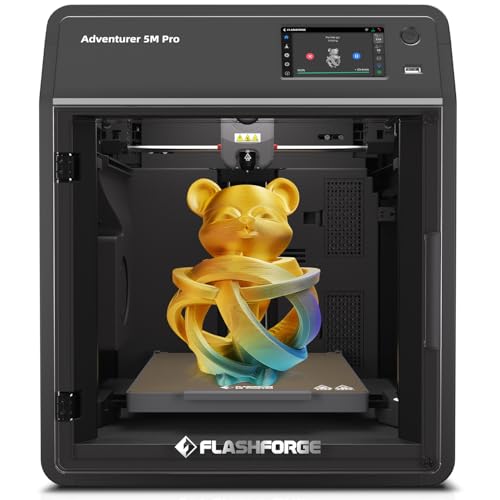
| Flashforge Adventurer 5M ProOnly Printer With HEPA and Carbon in Writing | 4 Multi-material | 220 mm cube | Yes, HEPA and activated carbon in writing | PLA, PETG, ABS, ASA, TPU, PLA-CF, PETG-CF (TPU and CF on 0.6/0.8 mm nozzles) | $359.00 |
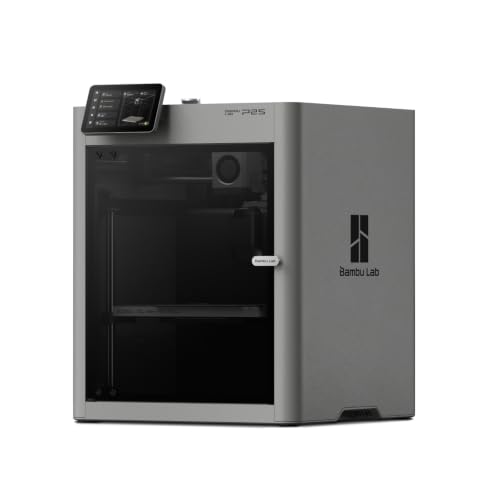
| Bambu Lab P2SCarbon Plus Stated VOC Filtration | 4 Multi-material | 256 mm cube | Yes, door sensor + activated carbon; maker states VOC filtration supported | PLA, PETG, ABS, ASA, TPU | $479.00 |
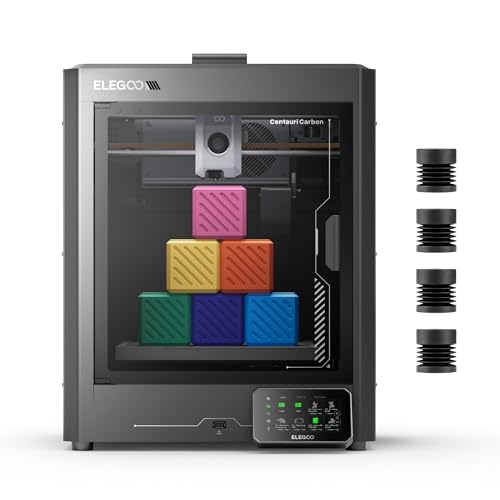
| ELEGOO Centauri CarbonCheapest Enclosed Printer With a Filter | 4 Multi-material | 256 mm cube | Yes | PLA, PETG, ABS, ASA, TPU | $329.25 |
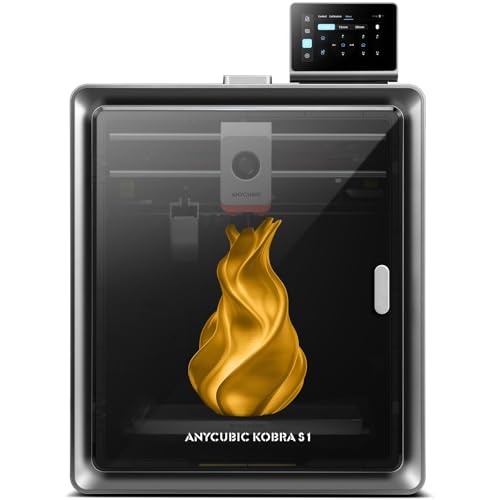 Anycubic Kobra S1Enclosed, Carbon Piece Included | 4 Multi-material | Not sourced yet | Not sourced yet | Not sourced yet | $399.99 |
Amazon prices as of Nov 23, 2026. Specs from each maker's own page, linked in each pick's build sheet.
Where these printers sit on the upgrade path
- Kid printer
- A1 mini class
- Full-size
- Enclosed multi-materialOutgrow first: rarely outgrown by a home beginnerFlashforge Adventurer 5M ProBambu Lab P2SELEGOO Centauri CarbonAnycubic Kobra S1
Stations follow build size, filament range and enclosure from each maker's spec page. The whole path
Each pick, and when you'd outgrow it
Flashforge Adventurer 5M Pro
The only printer on this page that states both particle and gas filtration in writing, which is what the emission studies recommend for a room with no other way to vent.
$359.00 at Amazon, as of Nov 23, 2026
- Build size
- 220 mm cube
- Enclosed
- Yes, HEPA and activated carbon in writing
- Filament
- PLA, PETG, ABS, ASA, TPU, PLA-CF, PETG-CF (TPU and CF on 0.6/0.8 mm nozzles)
You'll outgrow it when you leave apartment printing - filtration is its reason here
Ownership checks
- Cloud and firmware · Know this
- Recalls · Clear
- Spare parts · Know this
Full build sheet
Best for: A windowless room, since it is the only printer here with a stated HEPA-plus-carbon filter path
- Flashforge lists "internal circulation + external circulation (HEPA + activated carbon)", matching what UL and NIOSH recommend for VOC-plus-particle control
- Prints ABS and ASA per Flashforge, materials the emission studies flag as higher VOC emitters
- No study has tested this printer's specific filter; the maker's own description is the only source for its filtration numbers
- 380x400x453 mm per Flashforge, the largest footprint among the cheaper picks here
Year-one starter spend
| Printer | $359.00 |
|---|---|
| 4 kg of PLA | $41.48 |
| Filament dryer | $38.24 |
| Tool kit | $17.99 |
| Starting total | $456.71 |
Amazon prices as of Nov 23, 2026, add-ons from our gift guide. 4 kg of PLA is a starting stock, not a year's use. No sourced price yet for spare nozzles or build plates.
Path and specs from: FlashForge: Adventurer 5M Pro product page, Flashforge: Adventurer 5M Pro spec table, Filament row, fetched Nov 22, 2026
Bambu Lab P2S
The only printer here to list VOC filtration by name, at a real price jump over the P1S.
$479.00 at Amazon, as of Nov 23, 2026
- Build size
- 256 mm cube
- Enclosed
- Yes, door sensor + activated carbon; maker states VOC filtration supported
- Filament
- PLA, PETG, ABS, ASA, TPU
You'll outgrow it when you already own a P1S - the P2S is its revision, not a second printer
Ownership checks
- Cloud and firmware · Know this Bambu accounts; LAN-only mode documented
- Recalls · Clear 0 CPSC recalls as of Sept 29, 2026
- Spare parts · Know this Bambu ecosystem; revision so new that third-party coverage is thin
Full build sheet
Best for: A buyer over the $500 mark who wants Bambu's newest enclosure with a door sensor
- Bambu lists activated carbon plus "VOC Filtration: Supported", the only P-series page here to name VOC filtration as its own line item
- Enclosed design adds a door sensor per Bambu's spec page
- At $569.00 (Sept 25, 2026), the most expensive printer on this page
- Same Bambu Connect authorization workflow as the P1S applies here
Year-one starter spend
| Printer | $479.00 |
|---|---|
| 4 kg of PLA | $41.48 |
| Filament dryer | $38.24 |
| Tool kit | $17.99 |
| Starting total | $576.71 |
Amazon prices as of Nov 23, 2026, add-ons from our gift guide. 4 kg of PLA is a starting stock, not a year's use. No sourced price yet for spare nozzles or build plates.
Path and specs from: Bambu Lab: P2S specs page
ELEGOO Centauri Carbon
The budget floor for an enclosed printer with any named filter media, with the least third-party detail on what the filter actually removes.
$329.25 at Amazon, as of Nov 23, 2026
- Build size
- 256 mm cube
- Enclosed
- Yes
- Filament
- PLA, PETG, ABS, ASA, TPU
You'll outgrow it when multicolor arrives - the Carbon is single-color at heart
Ownership checks
- Cloud and firmware · Not checked App or account requirement not checked yet
- Recalls · Clear 0 CPSC recalls as of Sept 29, 2026
- Spare parts · Clear Elegoo sells spares; the platform is young but stocked
Full build sheet
Best for: The lowest price here for a fully enclosed chamber with a listed filter
- Elegoo calls it a "fully enclosed chamber" with a "nano mineral crystal filter" for particles and odors
- Enclosed, with a filter claim from ELEGOO, and a dated Amazon price beside the buy button
- "Nano mineral crystal filter" is Elegoo's own term; no independent measurement of it exists in the sources we read
- 398x404x490 mm per Elegoo, a large footprint for the price
- Owner reports (2 of 108 mentions read) describe an early top-cable failure and slow parts support; treat as a small sample, not a trend
Year-one starter spend
| Printer | $329.25 |
|---|---|
| 4 kg of PLA | $41.48 |
| Filament dryer | $38.24 |
| Tool kit | $17.99 |
| Starting total | $426.96 |
Amazon prices as of Nov 23, 2026, add-ons from our gift guide. 4 kg of PLA is a starting stock, not a year's use. No sourced price yet for spare nozzles or build plates.
Path and specs from: ELEGOO: Centauri Carbon product page
Anycubic Kobra S1
Enclosed with a carbon piece in the box, but Anycubic publishes the least detail here about what that piece filters or how.
$399.99 at Amazon, as of Nov 23, 2026
You'll outgrow it when multicolor stays occasional - the S1's value is the 4-color unit
Ownership checks
- Cloud and firmware · Not checked
- Recalls · Clear 0 CPSC recalls as of Sept 29, 2026
- Spare parts · Know this Anycubic sells spares direct; marketplace coverage thinner than Creality's
Full build sheet
Best for: A buyer who wants Anycubic's ACE Pro multicolor system in an enclosed body
- Anycubic calls it "Fully-Enclosed" and lists "Activated Carbon (1pcs)" in the box contents
- 400x410x490 mm per Anycubic, similar footprint to the Centauri Carbon
- No filtration spec row on Anycubic's page, only a box-contents line naming the carbon piece
- Ranked last here because its filtration claim is the least specific of the four
Year-one starter spend
| Printer | $399.99 |
|---|---|
| 4 kg of PLA | $41.48 |
| Filament dryer | $38.24 |
| Tool kit | $17.99 |
| Starting total | $497.70 |
Amazon prices as of Nov 23, 2026, add-ons from our gift guide. 4 kg of PLA is a starting stock, not a year's use. No sourced price yet for spare nozzles or build plates.
No owner reports or revision history collected yet for the printers on this page. Until there are, these picks show only what the maker and regulator sources say.
- No study measured a windowless bedroom or these printers' built-in filters. The closest data: a modeled bedroom (Davis et al. 2019) and a measured small unventilated room (Steinle 2016), neither a home with no window.
- Enclosures cut particles far more than VOCs. NIOSH measured 99.7% fewer particles but only 53.2% fewer total organics from the same ventilated enclosure.
- Only one printer here publishes both HEPA and carbon: the Flashforge Adventurer 5M Pro. The rest list carbon only, or an unspecified filter.
- PLA is not automatically the safe choice. In Steinle's test, PLA emitted more ultrafine particles than ABS on that printer; Zhang 2019 found PLA particles more toxic per mass in cell and mouse tests.
- No CPSC recall applies to any printer on this page (checked Sept 25, 2026). The only 3D-printer recall on record is the 2024 Bambu Lab A1, a different product line.
No study has measured a 3D printer running in a real windowless apartment room, but the closest evidence points one direction: control emissions at the source. The Flashforge Adventurer 5M Pro is the printer to start on here, the only one of four enclosed printers under $600 that states both a HEPA and an activated-carbon filter. Every emission figure below names its study and its setting: a lab chamber, an office, or a model, never these printers themselves.
Updated Nov 11, 2026: the Creality K1C is out of stock on Amazon and was removed from the ranking.
Read this first: UL says “a ventilated enclosure reduces particle concentration by 99.7% and TVOC concentration by 69.5%”; that is a ventilated enclosure, not a closed box with no exhaust path. UL’s advice to organizations is to “use enclosures with active local filtration systems equipped with HEPA filters for particles and activated carbon filters for VOCs” (UL Chemical Insights).
Safety before the first print
No study tested a real windowless bedroom, and no maker has published a tested reduction number for its own printer’s filter. Read the limits before the picks:
- No study here tracked long-term health outcomes in people; the toxicity comparisons between filaments (Zhang et al. 2019) are cell and mouse data, not human studies.
- The closest measurements to a windowless room are a modeled bedroom (Davis et al. 2019) and a measured small unventilated room (Steinle 2016); neither is a real home with no window at all.
- Enclosure studies mostly measured particles. Where VOC reduction was reported, it came in lower: 53.2% (NIOSH) and 69.5% (UL) against particle cuts of 99.7% in the same tests.
- Results vary by printer, filament, brand, color and nozzle temperature. None of the studies cited on this page tested the four printers named here.
- The research pass behind this page read study abstracts, not full texts.
What this means in practice: a room with no window removes the option the best-performing studies favored (venting outside), so the honest answer is to control emissions at the printer itself, through an enclosure with real filtration, and to accept that no study has measured how well that filtration actually works in a home.
No CPSC recall applies to any printer on this page as of Sept 25, 2026. The only 3D-printer recall on record is the June 2024 Bambu Lab A1, a different, non-enclosed printer line not sold here.
Printers worth starting on
Four enclosed printers were in stock on Amazon as of Nov 18, 2026 and publish some filter claim. Ranked by how specific that claim is, and what emissions research says such filters actually need to cover.
Every pick here already sits at the “enclosed” rung of the growth path (kid or toy printer, then an A1 Mini-class open-frame printer, then a full-size open-frame printer, then enclosed and multi-material). The next rung up from any of these is a multi-material system (an AMS/CFS unit) or a larger farm-style enclosure; none of the four needs replacing for build size alone within a normal first two years of use.
- Flashforge Adventurer 5M Pro ($359.00 on Amazon as of Nov 23, 2026): it carries the most specific filtration claim on this page (HEPA plus activated carbon, per Flashforge’s product page), so the next step up is a different printer class rather than a bigger filter.
- Bambu Lab P2S ($479.00 on Amazon as of Nov 23, 2026): already Bambu’s higher tier; the next step up is a multi-unit farm, not a bigger single printer.
- ELEGOO Centauri Carbon (out of stock on Amazon as of Nov 23, 2026): outgrows its filter claim first, since “nano mineral crystal filter” has no independent measurement; treat it as a particle-control device, not a VOC solution, until better data exists.
- Anycubic Kobra S1 ($399.99 on Amazon as of Nov 23, 2026): the least specific filtration claim here; outgrow it first by adding a stated HEPA or carbon-rated filter kit if you print ABS regularly.
Owner evidence, read and counted per printer (reddit, YouTube, Amazon and forum.bambulab.com, pulled Sept 25, 2026):
- Adventurer 5M Pro: 131 matching mentions read, 3 usable findings. Two owners describe pairing the printer with a separately bought or built enclosure rather than relying on the sealed chamber alone; a classroom buyer running 8 units reports high reliability and fast free parts replacement. No comment in the set described the HEPA-plus-carbon filter’s actual performance.
- P1S: 214 matching mentions read, the largest pool on this page, 2 usable findings. One owner with mild asthma in a windowless apartment said they did not trust the stock filter alone and added a third-party HEPA-plus-carbon filter plus a separate room air purifier; others cited dust control, not just fumes, as their reason for wanting the enclosure. Still thin relative to the mention count: most P1S discussion was general satisfaction and ecosystem opinion, not filtration.
- Centauri Carbon: 108 matching mentions read, 3 usable findings, none about the filter itself. Two owners reported a top cable breaking within the first two months, causing crashes; one described a PETG clog destroying toolhead parts with slow, error-prone parts support from Elegoo. This is a small sample, not a survey, but it is enough to flag before buying the cheapest pick here.
- P2S, Kobra S1: P2S and Kobra S1 returned no matching owner mentions at all in this pull.
- HEPA 13 + activated carbon 4-pack for Bambu Lab (companion pick): no owner mentions found.
The real total cost
A filter that needs replacing is part of the real price, not an afterthought. The P1S’s own filter category on Amazon lists a third-party HEPA-plus-carbon replacement combo ($18.99 on Amazon as of Nov 23, 2026) in stock when we re-checked on Oct 25, 2026; Bambu does not publish its own replacement-filter interval for the P1S or P2S. None of the makers on this page state a filter lifespan in the pages we read, so budget for checking the filter by smell or airflow rather than a fixed schedule. A filament dryer is a separate, near-universal add for any enclosed printer running PETG, nylon or TPU; expect roughly $30-90 for one (a comparable unit, the SUNLU S2, listed at $38.24 on Sept 25, 2026, though it is not one of this page’s ranked products).
What does buying three for a classroom or family cost?
Three of the cheapest pick here leave the most budget; a younger-kid option leaves even more. Three ELEGOO Centauri Carbons (unit price out of stock on Amazon as of Nov 23, 2026) cost the least of the full-size trios here against a $1,500 cap, leaving the most for filament and dryers; three Flashforge Adventurer 5M Pros (unit price $359.00 on Amazon as of Nov 23, 2026) cost more per unit, for the trade of matching HEPA-plus-carbon filtration on every machine; do the bench-width math yourself from each maker’s stated footprint. For younger kids where a 120 mm PLA-only build is enough, three Ugee Funboxes (a kids’ printer Ugee lists as “Fully Enclosed Printing” with “dual-layer H12 HEPA and activated carbon filters” and “PLA (Polylactic Acid)” as its print material, not one of this page’s ranked picks) cost the least of any setup here. Multiply each unit price by three, then by your local tax rate, for the real total; stock depth for a purchase of three was not confirmed, since the Amazon API used for this page returns in-stock status, not quantity, so a per-customer limit on any ASIN here is possible and unverified.
Elegoo’s own store no longer sells the original Centauri Carbon: its old product link opened the Centauri Carbon 2 Combo (under $400, in stock) on Nov 18, 2026, and Elegoo’s US store page for the Centauri Carbon 2 listed the printer without the multicolor unit under $350, also in stock. Both are newer models than the Centauri Carbon ranked on this page, so check their specs on Elegoo’s page before treating them as the same printer.
First-hour checks
- Run the first print with the enclosure fully closed, matching how the maker’s filtration claim is meant to work.
- Note any smell during the print.
- Wait roughly 20 minutes after the print finishes before opening the enclosure, per NIOSH’s clearance-time guidance, rather than opening it immediately.
- Check the exhaust or filter cartridge is actually installed; several of these printers ship the carbon element as a separate part in the box, not pre-installed.
- If printing ABS or ASA on the AD5M Pro or Centauri Carbon, run the first batch with a window cracked if one exists nearby, even though these printers are made for enclosed operation.
Which of these is actually the quietest, by the numbers?
Only two makers here publish a checkable dB figure, and Bambu publishes none. Flashforge’s Adventurer 5M Pro states “Low-noise mode: 50dB; Standard mode: 55dB” and ELEGOO’s Centauri Carbon is rated “≤55 dB” (Elegoo’s own spec page). Bambu publishes no dB figure for the P2S at all. We could not re-verify Anycubic’s Kobra S1 noise figure on Nov 11, 2026 because its store page returned an error, so none is given. None of these numbers were measured the same way, so a lower claimed figure is a manufacturer’s own lab result, not proof one printer is quieter than another in a specific windowless room.
Specs that matter for a first printer
| Printer | Enclosure (maker’s words) | Filter (maker’s words) | Footprint | Handles ABS/ASA? |
|---|---|---|---|---|
| Adventurer 5M Pro | “Shell Enclosed” | Internal + external circulation, HEPA + activated carbon | 380x400x453 mm | Yes |
| P2S | Enclosed, door sensor | Activated carbon, “VOC Filtration: Supported” | 392x406x478 mm | Yes |
| Centauri Carbon | “Fully enclosed chamber” | “Nano mineral crystal filter” | 398x404x490 mm | Yes |
| Kobra S1 | “Fully-Enclosed” | Activated carbon (1 piece, box contents only) | 400x410x490 mm | Yes |
Prices and stock are Amazon’s as of Oct 9, 2026; the Adventurer 5M Pro listing went out of stock briefly on Oct 8, 2026 and is back in stock at $379.00 on Amazon’s product data as of Oct 9, 2026.
- Adventurer 5M Pro: $359.00 on Amazon as of Nov 23, 2026
- P2S: $479.00 on Amazon as of Nov 23, 2026
- Centauri Carbon: out of stock on Amazon as of Nov 23, 2026
- Kobra S1: $399.99 on Amazon as of Nov 23, 2026
So, which one?
For a windowless apartment room, the Adventurer 5M Pro ($359.00 on Amazon as of Nov 23, 2026) is the one printer here with both particle (HEPA) and gas (activated carbon) filtration stated by the maker, matching what NIOSH and UL’s guidance recommends when venting outside is not an option.
If Bambu’s ecosystem matters more than filter completeness, the P2S ($479.00 on Amazon as of Nov 23, 2026) is the in-stock Bambu here and the only printer on this page to list VOC filtration by name, alongside the January 2025 firmware authorization tradeoff. The P1S is not ranked: its Amazon listing is out of stock as of Nov 18, 2026.
For an enclosed printer with a filter claim, the Centauri Carbon (out of stock on Amazon as of Nov 23, 2026) qualifies, though its filter claim has the least independent backing of the four.
None of these printers has been tested by an independent study for its actual emission reduction. Choosing one is choosing a maker’s claim, backed by general research on what enclosures and filters can do, not a measurement of that printer.
Update history
- Nov 18, 2026: moved the Bambu Lab P1S to Also considered (out of stock on Amazon) and updated every count that named it.
- Nov 11, 2026: removed the Creality K1C (out of stock on Amazon) and updated every count and comparison that named it.
- Nov 11, 2026: removed the Kobra S1 noise figure because Anycubic’s store page returned an error and the quote could not be re-verified.
- Nov 11, 2026: sourced the Ugee Funbox filter wording to Ugee’s own page.
- Nov 11, 2026: added a UL emissions warning with a linked source near the top.
Also considered, and why they are not ranked
- Creality K1C 3D Printer: Removed from the ranking: out of stock on Amazon as of Nov 11, 2026. It was the carbon-only, smaller-footprint pick.
- Bambu Lab P1S 3D Printer: Removed from the ranking: out of stock on Amazon as of Nov 18, 2026 (Amazon's product data). It was the carbon-filter Bambu pick; the in-stock P2S is the Bambu left here.
- TIOPY Activated Carbon Air Filter for Bambu X1C/P1P/P1S/X1/X1E: In stock at $8.99 on Sept 25, 2026, but it is a replacement part, not a printer, so it is not ranked; it is named in the total-cost section.
- Diyover HEPA H13 + carbon filter system, BlueDate 3D printer air purifier, Creality 3D Printer Air Purifier: Live on Amazon Sept 25, 2026 but not researched against a maker spec page; Creality's own store also lists a different price for what looks like the same purifier, so it is left out rather than guessed at.
- Room air purifiers (Levoit, WINIX): In stock, but no study in our source set tested a room purifier against 3D printer emissions specifically, so a listing here would imply a claim we cannot back.
First-printer questions
Can I run a 3D printer in an apartment room with no window if it's enclosed with a carbon filter?
No study measured that exact setup. The studies that exist favor controlling emissions at the source, meaning an enclosure with filtration or exhaust vented outside, over relying on room air. A windowless room removes the outside-vent option the highest-performing studies rated best, so an enclosure with both HEPA and carbon, like the Adventurer 5M Pro's, is the closer match to what NIOSH and UL recommend.
Are 3D printer fumes dangerous in a bedroom?
Steinle (2016) measured a small unventilated room and found particle counts rise by about 2,000 per cm3 during printing, with one VOC (MMA) still detectable 20 hours later. Davis et al. (2019) modeled a bedroom and found some chemicals exceeded recommended indoor levels. Neither study used a real bedroom with no ventilation at all, and neither tracked long-term health outcomes.
Does a 3D printer enclosure actually reduce fumes?
It reduces particles far more than it reduces VOCs. NIOSH measured a ventilated enclosure cutting particles by 99.7% but total organics by only 53.2% in the same test. Viitanen's office study found enclosure alone cut particle surface area by 89%, and adding local exhaust reached 96%.
Is PLA safe to print indoors without ventilation?
Don't assume it. In Steinle's test, the printer emitted more ultrafine particles running PLA than ABS. Zhang et al. (2019) found PLA particles more toxic per unit mass than ABS particles in cell and mouse tests. ABS and nylon are still the bigger VOC emitters (Azimi 2016, Davis 2019), so material choice is not a single clean answer.
Do built-in carbon filters on printers like the P1S actually work?
No maker on this page publishes a tested emission-reduction number for its own filter. The P2S lists activated carbon and VOC filtration by name; the Adventurer 5M Pro is the only one that adds HEPA to that claim. Independent chamber and office studies (NIOSH, UL, Viitanen) show enclosures with filtration can cut particles by 89-99.95%, but none of those studies tested these specific printers.
How long should I wait before opening the enclosure after a print?
NIOSH's 2024 guide for makerspaces and schools suggests roughly 20 minutes of clearance time before opening an enclosure, so particles and gases have time to settle or clear through filtration rather than releasing into the room all at once.
Which of these is actually the quietest, by the numbers?
Among these four, Flashforge states "Low-noise mode: 50dB; Standard mode: 55dB" and ELEGOO rates the Centauri Carbon "≤55 dB" on its own spec page; Bambu publishes no dB figure at all for the P2S. We could not re-verify Anycubic's noise figure for the Kobra S1 on Nov 11, 2026 because its store page returned an error, so no figure is given for it. These claims were not measured the same way, so treat a lower claimed number as directional, not proof one printer is quieter in your specific room.
Sources we checked
- Azimi P et al., 'Emissions of Ultrafine Particles and Volatile Organic Compounds from Commercially Available Desktop Three-Dimensional Printers with Multiple Filaments' (Environ Sci Technol, 2016). Source for ultrafine particle rates (10^8-10^11/min) and styrene/lactide emission rates by filament.Independent · pubmed.ncbi.nlm.nih.gov · checked
- Steinle P, 'Characterization of emissions from a desktop 3D printer and indoor air measurements in office settings.' Source for PLA emitting more ultrafine particles than ABS on that printer, and the small unventilated room result (+2,000 particles/cm3, MMA detectable 20 hours later).Independent · pubmed.ncbi.nlm.nih.gov · checked
- Davis AY et al., 'Characterization of volatile organic compound emissions from consumer level material extrusion 3D printers' (Building and Environment, 2019). Source for the modeled bedroom exceeding recommended indoor levels for some chemicals, and TVOC range 147-1660 micrograms/hour.Independent · doi.org · checked
- Stefaniak AB et al. (NIOSH), particle and VOC reduction from a ventilated enclosure in four real workplaces. Source for 99.7% fewer particles, 53.2% fewer total organics.Regulator · pubmed.ncbi.nlm.nih.gov · checked
- UL Chemical Insights, 3D printing emissions page. Source for "reduces particle concentration by 99.7% and TVOC concentration by 69.5%" (ventilated enclosure) and the advice to use "enclosures with active local filtration systems equipped with HEPA filters for particles and activated carbon filters for VOCs", and to limit time near the printer in the first 20 minutes.Independent · chemicalinsights.ul.org · checked
- Kwon O et al., nanoparticle removal by an enclosure with HEPA. Source for 99.95% nanoparticle removal.Independent · pubmed.ncbi.nlm.nih.gov · checked
- Viitanen AK et al., 'Technical control of nanoparticle emissions from desktop 3D printing' (Indoor Air, 2021). Source for room ventilation being insufficient, enclosure alone -89%, enclosure plus local exhaust -96%.Independent · pubmed.ncbi.nlm.nih.gov · checked
- Barnes C et al. 2025 (NIOSH), chamber test of ABS printing with and without enclosures. Source for enclosures alone cutting particles 67-95%, venting outdoors reaching 98.35% or more.Regulator · doi.org · checked
- NIOSH Pub. 2024-103, 'Approaches to Safe 3D Printing.' Source for source control over dilution ventilation and a roughly 20-minute clearance time before opening an enclosure.Regulator · doi.org · checked
- NIOSH Pub. 2020-115 fact sheet. Source for HEPA local exhaust, gas/vapor filters for VOC concerns, and choosing the lowest printing temperature.Regulator · cdc.gov · checked
- Zhang Q et al. 2019, cell and mouse toxicity of 3D printer particles by filament type. Source for PLA particles showing higher toxicity per mass than ABS in these tests.Independent · pubmed.ncbi.nlm.nih.gov · checked
- Flashforge: Adventurer 5M Pro product page. Source for 'Shell Enclosed', the HEPA plus activated-carbon filtration description, 380x400x453 mm, and ABS/ASA compatibility.Manufacturer · flashforge.com · checked
- Bambu Lab: P2S specs page. Source for the enclosed design with a door sensor, activated carbon, and 'VOC Filtration: Supported'.Manufacturer · bambulab.com · checked
- ELEGOO: Centauri Carbon product page. Source for the 'fully enclosed chamber' description and the nano mineral crystal filter claim.Manufacturer · elegoo.com · checked
- Anycubic: Kobra S1 product page. Source for the 'Fully-Enclosed' description; the activated carbon piece is listed in the box contents with no filtration spec row.Manufacturer · store.anycubic.com · checked
- CPSC: Bambu Lab Recalls A1 3D Printers Due to Electric Shock and Fire Hazards (June 13, 2024). Source for the only 3D-printer recall on record; it names the A1, not any printer on this page.Regulator · cpsc.gov · checked
- Ugee: Funbox 3D Printer product page. Source for "Fully Enclosed Printing", "dual-layer H12 HEPA and activated carbon filters" and "PLA (Polylactic Acid)" as the print material.Manufacturer · shop.ugee.com · checked
- Amazon product data pull. Source for price, stock status and buy-box seller for every ASIN on this page.Retailer listing · amazon.com · checked
- 3D Printing Industry, Jan 20 20253dprintingindustry.com · Bambu’s January 2025 firmware authorization update and its stated justification